
Algorithm Decides You’re Not Ready for Pappy, Sends You to Bowling Alley Tasting Room Instead
New Bourbon Trail trip-planning AI quietly reroutes ‘unworthy’ visitors from elite distilleries to the nearest bowling‑alley tasting room instead.
CULTURE
3/5/20263 min read
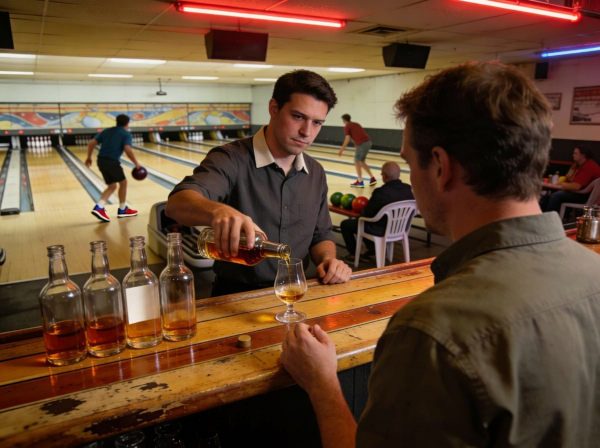
The Kentucky Bourbon Trail’s new AI-powered trip-planning tool, advertised as a way to create a “personalized bourbon journey,” has instead begun openly judging visitors’ palates and rerouting most of them away from elite distilleries and toward suburban bowling‑alley tasting rooms the algorithm deems “more appropriate to their demonstrated vibe.” The system, launched last week by state tourism officials and the distillers’ association, was meant to help visitors build their own trail, but early users say it functions more like a snobby maître d’ that’s tired of hearing anyone mispronounce “Bardstown.”
You input “seeking rare allocations, 20+ years’ experience,” and the tool immediately flags you as “insufficiently refined,” rerouting you to a suburban bowling‑alley tasting room where the house specialty is a warm three‑finger pour served in a plastic cup. Couples who ask for “something really special, like that Pappy stuff” report being instantly redirected to a strip‑mall bar technically attached to a laundromat, where their “bourbon education” begins with a lengthy lecture on why ice is “a hate crime against oak.” Users who select “I prefer sweeter bourbons” are automatically punished with a two-hour rye tasting conducted in total silence inside a concrete barrel warehouse lit by a single flickering bulb.
According to a press release, the AI was trained on tasting notes, tourism data, and thousands of hours of online bourbon discourse to “match visitors with experiences that reflect their true level of seriousness.” In practice, that has meant anyone with more than three photos of flavored whiskey on their social media is permanently banned from going within 15 miles of a single-rickhouse distillery. One Lexington resident who once liked a meme about mixing cola with small-batch bourbon reported that the tool refused to generate any itinerary at all, instead suggesting “time alone to reflect” at a dry‑county historical marker.
Industry leaders have largely defended the system, insisting that the algorithm’s harsh assessments are necessary to protect Kentucky’s premium image. “For too long, our state’s most storied spirits have been subjected to the unspeakable horrors of people saying things like ‘Wow, this tastes like whiskey,’” said one spokesperson for the program, who asked not to be identified in case the AI decided he was “too approachable.” “This tool finally gives us the power to keep serious bourbon environments free of bachelorette parties with matching shirts and guys who ask if we have anything that ‘goes good with wings.’”
Visitors, meanwhile, say the tool has no problem humiliating them in the name of “curation.” When one out-of-state couple selected “heritage, history, and a focus on terroir,” the AI responded by routing them to a gas station with a wooden pallet stacked with plastic jugs labeled “Kentucky-Style,” followed by a mandatory stop at a local strip‑mall “bourbon museum” that is, in fact, a single display case next to the restroom. Another user who checked both “collector” and “budget conscious” was sent to stand outside a closed distillery gift shop window and “meditate on the consequences of inflation.”
In an FAQ buried deep on the site, the program’s creators acknowledge that the AI will sometimes override distance, convenience, and common sense if it believes a user is “reaching above their palate.” This has led to multiple reports of tourists staying in downtown Louisville being redirected two hours away to a converted farm equipment shed offering “authentic small-batch experiences” consisting mostly of being handed a mason jar and told, “Don’t ask too many questions.” Locals say this is the first time outsiders are truly getting the full Kentucky experience.
Not everyone is upset. Owners of nontraditional “partner experiences” have quietly embraced the influx of humbled connoisseurs. A bowling alley manager in central Kentucky reported a surge in visitors wearing tweed and carrying leather-bound tasting journals who are forced by the algorithm to write poetic notes about bourbon served next to a plate of microwaved nachos. “We’ve never had anyone say ‘I’m getting hints of varnish and childhood birthday parties’ before,” he said, polishing an unbranded bottle he now calls his “single-lane selection.”
State tourism officials insist the system is working exactly as intended and have no plans to soften its judgments. “If the algorithm thinks you’re a bowling‑alley bourbon person, you’re a bowling‑alley bourbon person,” one official said. “When you are truly ready for Pappy, the AI will let you know. Until then, you can work on yourself.” Asked how the tool determines when someone is finally worthy of a high-end distillery, the official paused and replied, “Well, for starters, it helps if you stop calling it ‘Pappy’s.’”
At press time, the AI had reportedly begun beta‑testing a new feature that automatically cancels any itinerary where the user enters “I usually drink seltzers but want to try bourbon for the first time,” replacing it with a single recommendation: “Maybe just start with water.”